
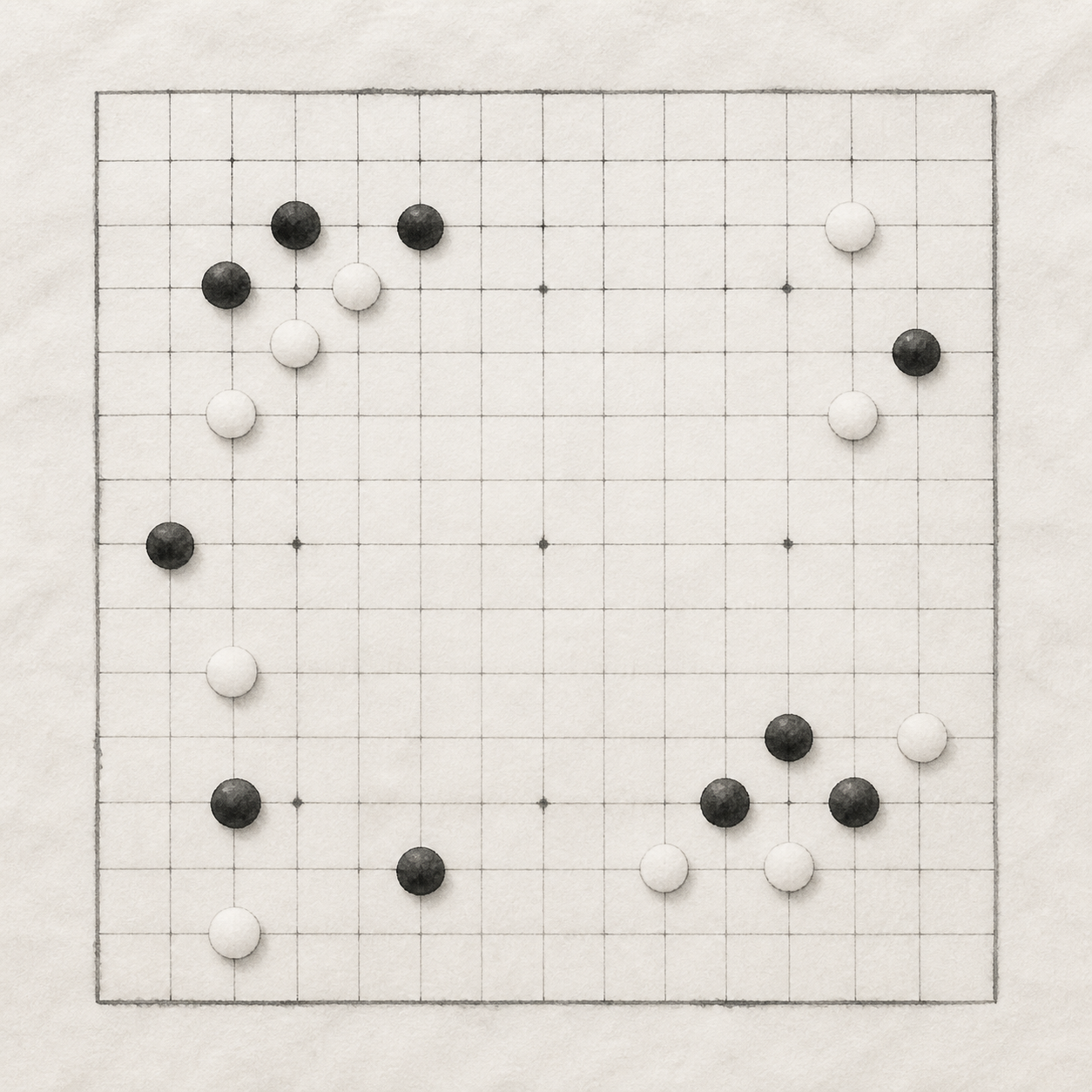
A stone placed on an intersection reads differently from a stone placed inside a square. Much of Gomoku’s lightness lives in that small choice: the lines arrive first, the point gains meaning, and direction becomes easier to see.
From square centers to intersections
Many first-time players picture Gomoku as a game of filling squares. The actual convention is closer to Go: stones sit on the crossings of the lines. RenjuNet’s beginner rules make the same point, noting that moves are placed on line intersections, not in the middle of squares.
That distinction is more than layout. A stone inside a square makes the board feel like a table. A stone on an intersection turns it into a network. Horizontal, vertical, and diagonal lines all begin at the same point, so you read direction before you read cells.
Intersections make direction fairer
Gomoku depends on four directions: horizontal, vertical, and the two diagonals. An intersection belongs to all of them at once. As soon as a stone lands, the surrounding lines suggest where it might extend.
When stones sit in square centers, diagonal relationships feel weaker. Your eye has to pass through corners before linking the centers. Intersections gather those directions into one visual node, so diagonal reading needs less translation.
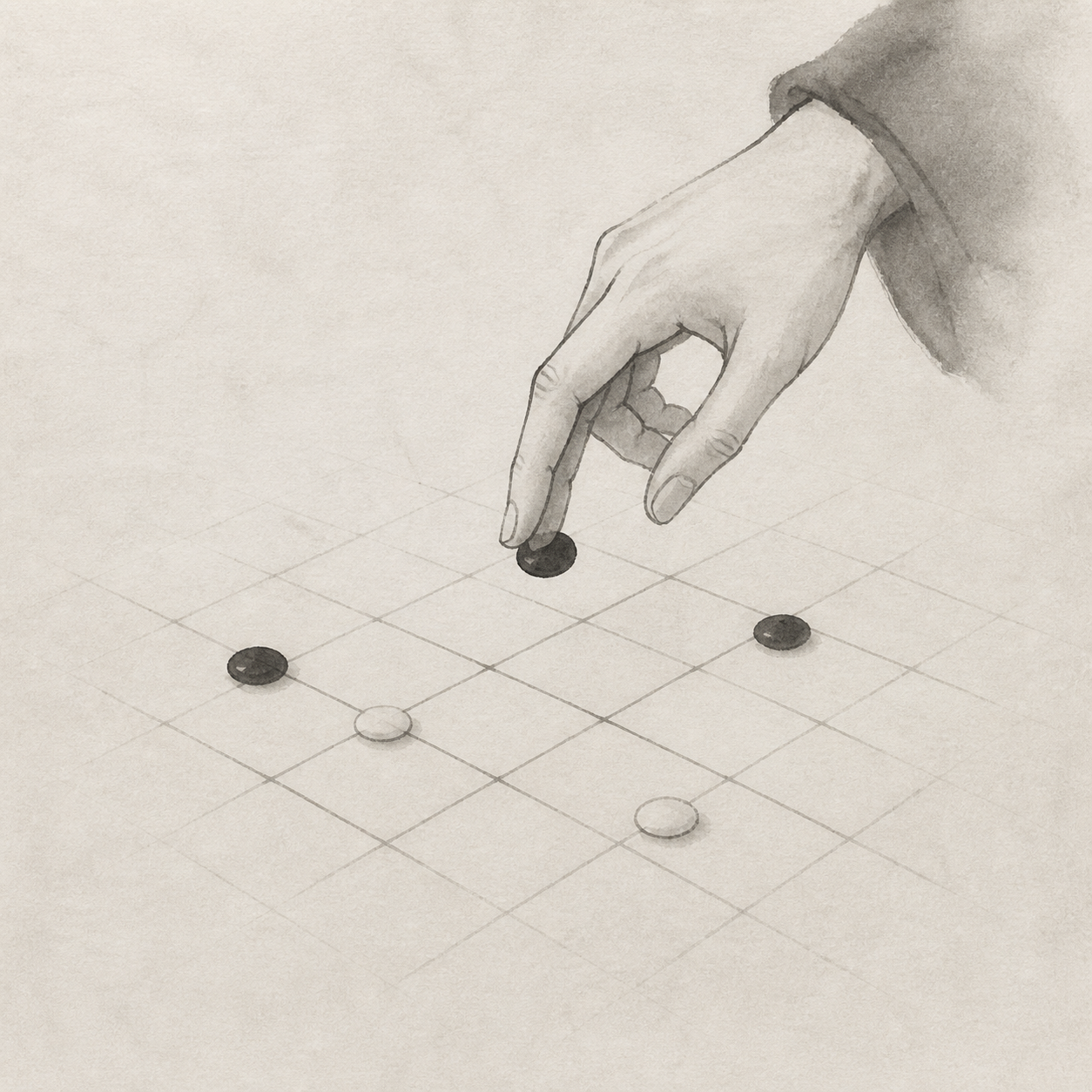
It changes the hand feel too
On a physical board, the crossing gives a slight sense of placement. The stone pins the meeting point of several lines without filling a compartment. Before your finger leaves it, you can feel how the move relates to nearby paths.
On a phone, that feeling is harder to preserve. The touch target must be generous, while the visual stone still has to feel precise. A modern board like WUZIQI has to manage the distance between what the finger can hit and what the eye can trust.
A good board quiets the landing point first.
Intersections are harder on a phone
Physical stones have thickness and edges. On screen, a stone is pixels, shadow, and animation. If the crossing is too fine, the player suspects a missed tap; if the stone is too large, nearby lines disappear underneath it.
That is why mobile board design often comes down to proportion. Grid spacing, stone diameter, line opacity, and placement animation all affect whether a move feels settled.
Why the board feels quieter
An intersection board has a natural advantage: empty space is organized by lines. With only a few stones, the scene still has order. As the board fills, the lines keep supplying direction.
This is why Gomoku responds well to calm design. It needs little decoration to announce itself as a board game. When line, point, and stone sit in the right proportion, the rhythm is already there.
Design beyond the rules
Renju rules also describe the standard board as a grid of fifteen lines, with stones added and never moved after placement. Those simple rules give interface design a clear boundary: the board should not perform too much; the change should come from the landing point itself.
Historically, five-in-a-row games have moved across Go boards, paper grids, and boards of different sizes. The lasting intersection system shows more than habit. It is a mature choice for readability.
How to look at the next game
Before the opening move, look at the lines around tengen before hunting for the strongest move. In the middle game, notice which directions one stone holds at the same time. Near the end, check the diagonals that slipped out of view.
That is the value of the intersection. It turns the board from a container for pieces into a surface for relationships. Once you see that, many attacks start to show their shape earlier.
One stone often holds several roads.