
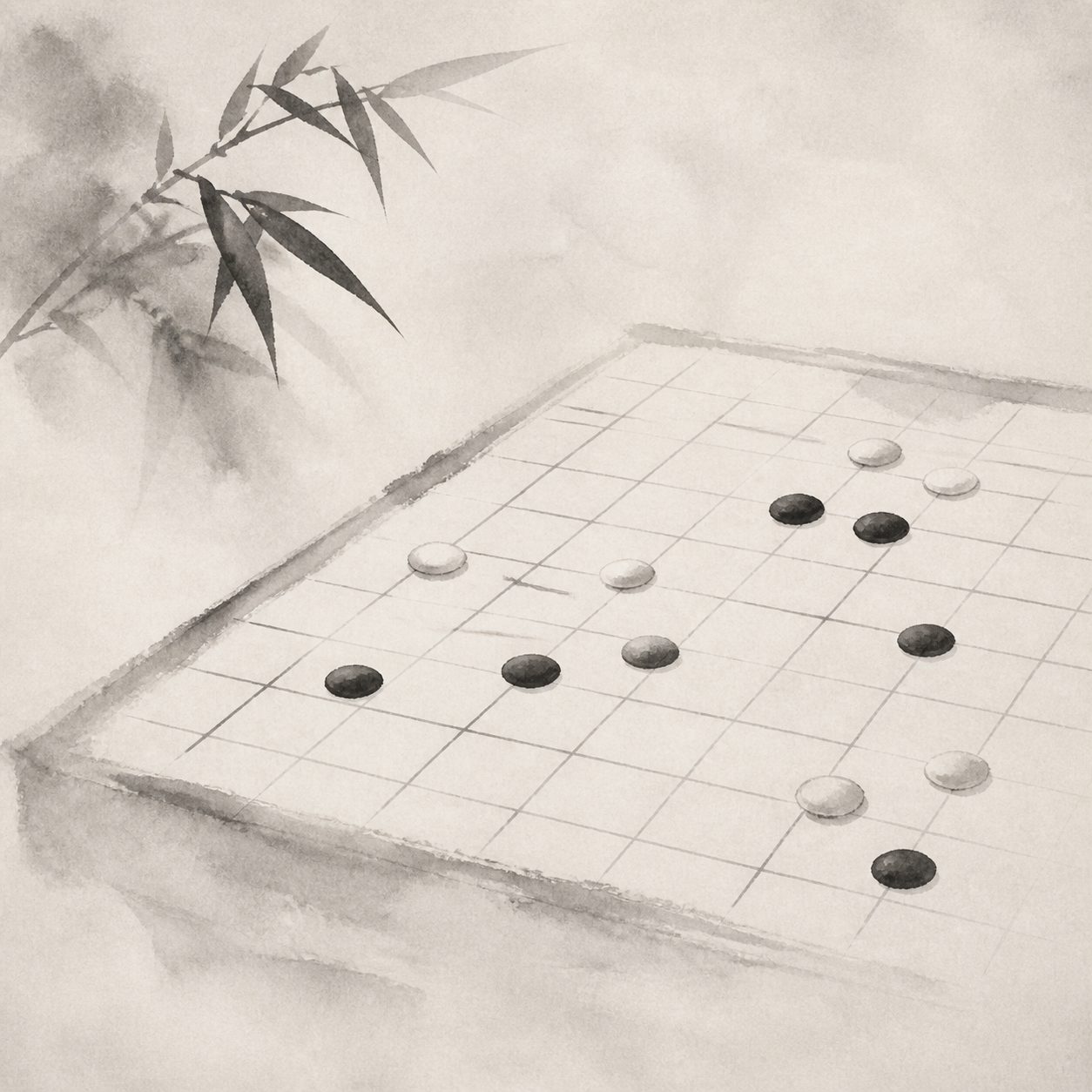
In Gomoku, “proof” means finding a path from which the opponent cannot escape no matter how they answer, rather than calculating every variation evenly. Open threes, four-in-a-row, and open fours are only signposts; what matters is whether they can be joined into a forced winning line.
From Strong Moves to Provably Strong Moves
Many positions look dangerous: an open three sits on the board, with a potential blocked three nearby. But strong does not mean winning. A provably strong move requires the next threat to force the opponent to defend, and after that defense, still leave a new forcing point.
For example, Black forms a horizontal open three. Must the opponent block one end? Not necessarily. If White can create a four-in-a-row at the same time, Black cannot simply follow their own script. When judging threats, the opponent’s strongest counterattack must also be included in the calculation.
VCF: Proving with Continuous Fours
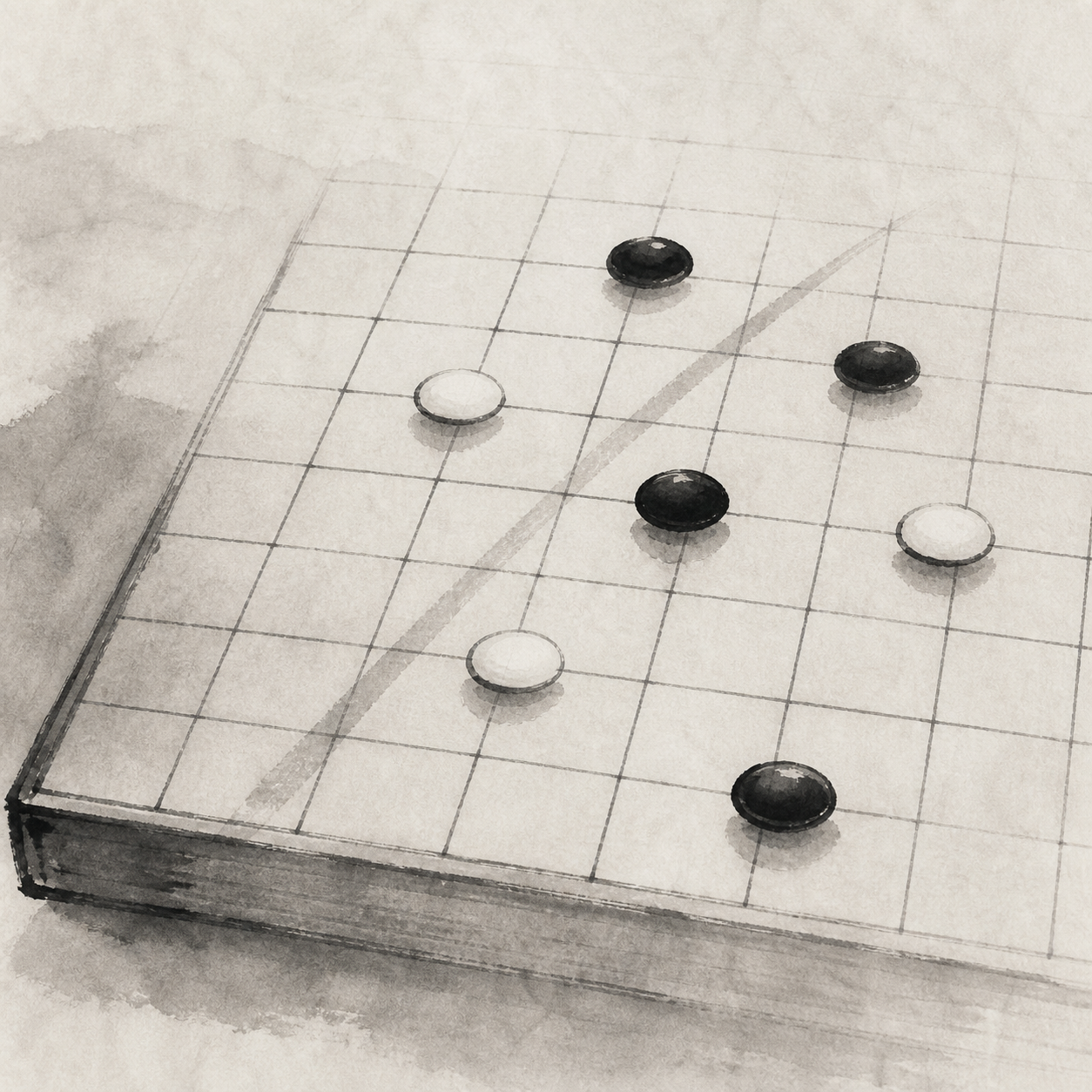
VCF is often explained as “Victory by Continuous Four,” winning by using fours in succession. Its character is direct: every move creates a four-in-a-row or an open four; if the opponent does not block, the next move makes five in a row.
VCF calculation is relatively clear because there are usually few defensive points. Black makes a four-in-a-row, White can only block the designated point; Black then makes another four-in-a-row elsewhere, and White is again forced to answer. As long as the chain does not break, a point will eventually appear that White cannot cover.
This is also why strong players look at fours before threes. A four has the highest forcing power; it compresses the position into a small number of branches. For the basic concept of VCF, see VCF and VCT concepts in gomoku.
VCT: Keeping the Initiative with Threats
VCT means “Victory by Continuous Threats.” It does not require every move to be a four; it can also use open threes, double threes, blocked threes that turn into open threes, and other ways to keep creating threats that must be answered.
VCT is broader than VCF, and harder. An open three often has to be defended, but the opponent may choose to create a more urgent four instead, or use one move to defend and counterattack at the same time. For this reason, a VCT proof must examine more defensive options.
VCF is like a narrow bridge: the opponent can only retreat. VCT is like a net: the key is confirming that every exit is covered by a threat.
Open Threes and Open Fours Are Language, Not Conclusions
To say “I have an open three” is only to describe a shape; to say “this open three is winning” is a conclusion. What is missing in between is the threat sequence: where I play next if the opponent defends here; whether I can still keep the initiative if the opponent defends another way.
A common misjudgment is to treat a double open three as an immediate winning advantage. If the rules or the position allow the opponent to make an open four on the next move, the double open three may actually be too slow. The urgency of threats has to be compared again in the order of five, open four, four-in-a-row, and open three.
For a more systematic account, see Threat sequence theory in gomoku strategy: a threat is a continuous structure with a set of responses, not just an isolated pattern.

PNS: Turning “Can It Be Proved?” into a Search Problem
PNS, or Proof-number search, is often used to determine whether a target can be proved. In Gomoku, the target might be “Black has a forced winning threat sequence from this position.”
It does not expand all variations evenly, but gives priority to the branches closest to proof or closest to disproof. If an attacking point needs only one key reply to close the line, the search will concentrate there; if a defense can break all threats, it will also be tested first.
This explains why “proof” often feels more like reading than brute force: it looks with greater purpose, first asking which branches are closest to holding up, or closest to being overturned. For related methods, see Proof-number search in gomoku.
What a Forced Winning Line Must Satisfy
First, every threat must be urgent enough. If the opponent can ignore it and make a larger threat, the line is broken. Second, the defensive branches must be complete. It is meaningless to prove only that the opponent “usually blocks on the left”; one must also prove that blocking on the right, countering with a four-in-a-row, or defending and counterattacking at once all fail.
Third, the line must finally converge into a clear winning shape: five in a row, a double four that cannot be stopped on both sides, or the end of a continuous-four sequence. An attack without a point of convergence is pressure, not proof.
Training a Sense of Proof Through Review
To train a sense of proof, start with short VCF lines: restrict yourself to finding only continuous fours, until you can quickly see forcing chains of three to five moves. Then add open threes, and practice judging which threes truly force a defense and which merely look good.
Some competition programs and architecture notes also emphasize this layering: first use pattern recognition to find candidate threats, then use search to verify forcing sequences. See Starpoint and TKGOMOKU architecture notes from Gomocup 2026.
For players, the value is not in the terminology itself, but in the way of thinking: ask whether every open three can continue, whether every four-in-a-row is unique, and whether every attacking line can withstand the opponent’s most stubborn defense.