
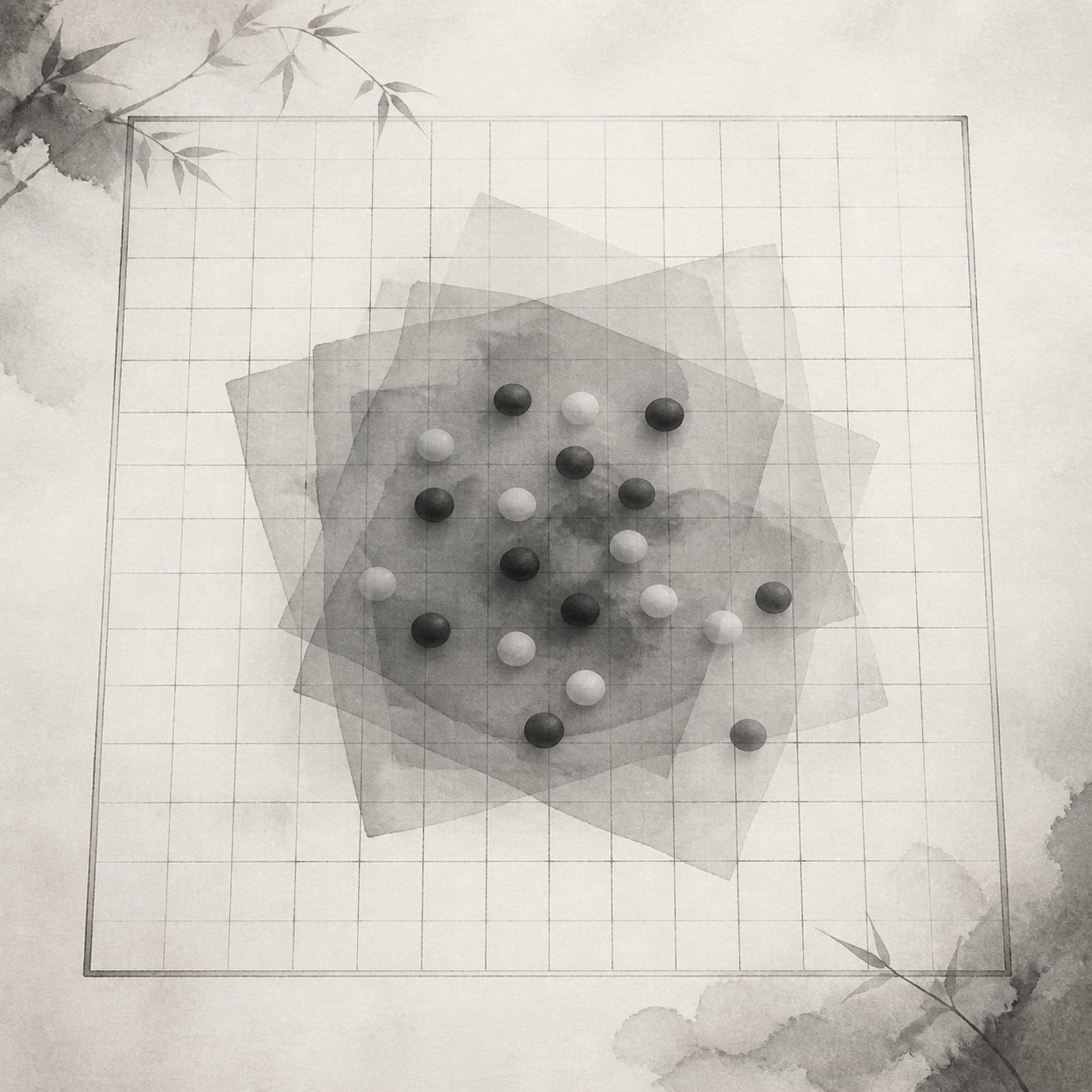
When you review a game, your eye tends to go first to the bright evaluation score: Black is better, White is better, or some win rate suddenly jumps. The puzzling part usually comes a second later. Only one stone has been added to the board. Why did the number move as if someone shoved it? To read it well, start by looking away from the number and toward the structure.
First, ask who owns the tempo
A Gomoku engine’s evaluation often compresses several things into one display: win rate for the side to move, search depth, or a positional score. The number looks like a conclusion. It is closer to a folded map: which line is forming, which intersection still offers a turn, which move will force the opponent into a single reply.
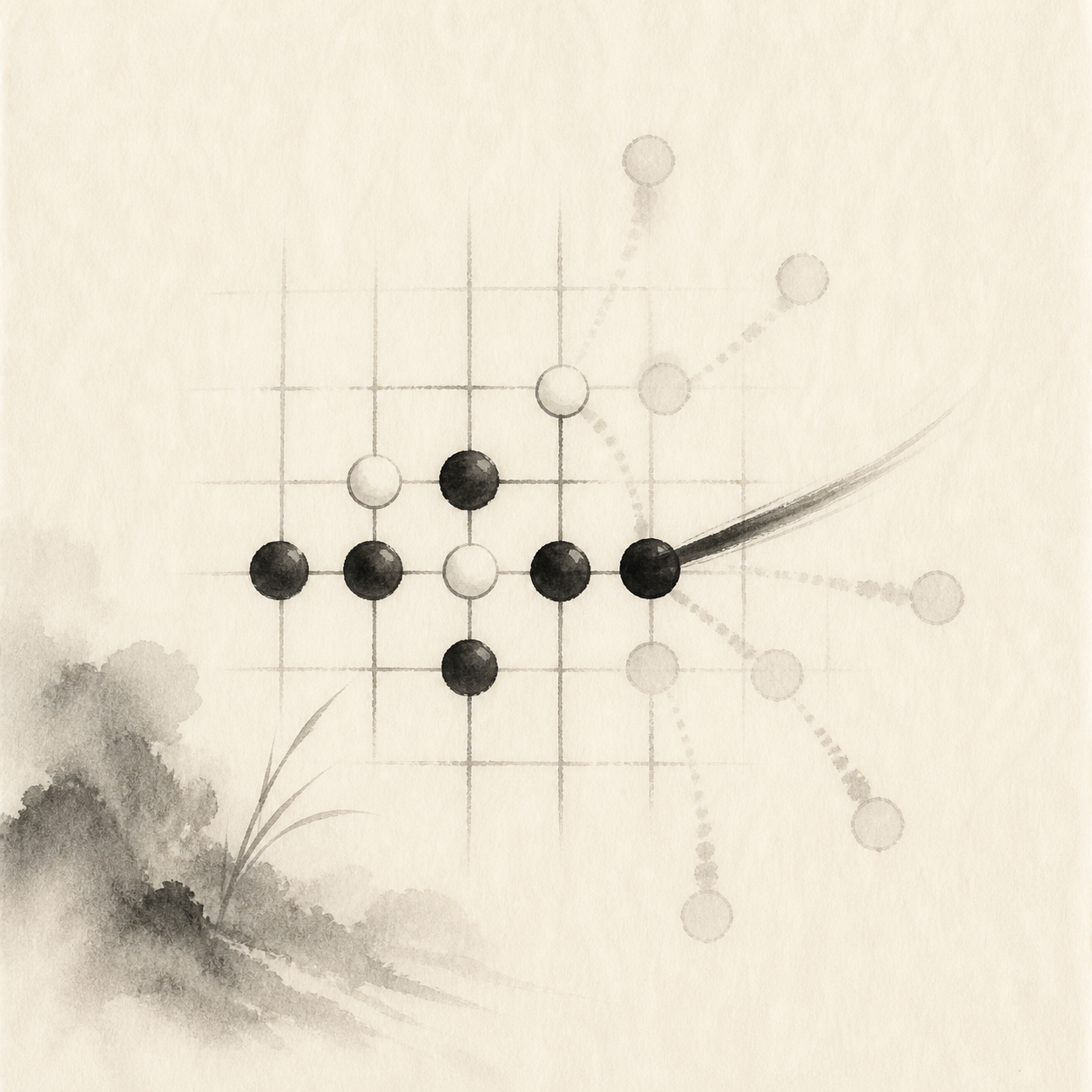
Take a 15-by-15 board. Black has stones on H8, I8, and J8; White has H7 and I7. If Black plays K8, the horizontal line becomes an open-four with both ends available. White’s next move usually has to block either G8 or L8. The evaluation rises here not because the stone on K8 is beautiful in itself, but because it narrows White’s choices.
Threats matter more than stone counts
Human readers often count stones: three, then four, then one more. Engines are more sensitive to the rank of a threat. A closed three, an open three, a four-in-a-row, and an open-four may differ by only one or two intersections, but their evaluation can be far apart because they impose different defensive costs.
Here is a small example. Black has G8, H8, and I8; White already occupies F8. If Black plays J8, Black creates a four-in-a-row to the right, and White can slow it down by blocking at K8. But if Black also has a diagonal idea with G9 and H10, the move J8 may open a second route at the same time. An engine will count that linkage, so the score is no longer describing only one line.
Threat-space search explains the pressure
If you look only at rankings, it is easy to imagine an engine as simply “the one that calculates deeper.” Public competitions give useful reference points. The official Gomocup results page, for instance, collects results from past years; for 2026 as well, the official page should come first before anyone starts comparing program styles.
The idea is plain: look ahead mainly along forcing threats. If one side keeps making four-in-a-row threats, open threes, and double threats, the defender’s reply set shrinks fast, and the search tree narrows with it. Sharp changes in evaluation often happen at exactly that moment, when the branches suddenly become few.
Scores jump when choices disappear.
Good Gomoku points are not always glued to existing stones. Some intersections do not immediately make a three or a four, but they touch a horizontal line, a vertical line, and a diagonal at once. Engines give those intersections extra weight because they can later turn into several kinds of threats.
Tournament results tell only part of the story
If you look only at standings, it is easy to reduce an engine to “the one that searches deeper.” Public competitions are useful references. The official Gomocup results page, for instance, collects results across years; when discussing the 2026 results, editors should rely on what that official page publishes rather than treating rumors as scores.
But rankings cannot directly explain why a particular position was overvalued or undervalued. One engine may be steadier in its opening book; another may be stronger at converting middle-game threats. Only by putting results next to concrete positions can you see whether the difference lies in search, evaluation, or time management.
Modern engines often connect two abilities. One tries moves forward; the other judges whether a leaf position is worth continuing. For the basic framework of Monte Carlo tree search, see the survey paper by Browne and colleagues. The origins of transformer evaluation networks trace back to Vaswani and colleagues’ paper on attention.
比赛结果只能告诉我们一部分
如果只看名次,很容易把引擎理解成“谁算得更深”。公开赛事能提供参照,例如 Gomocup 官方结果页会整理历年比赛结果;编辑讨论 2026 年结果时,也应以该官方页面公布内容为准,避免把传闻当成成绩。
但比赛排名无法直接说明某个局面为什么被高估或低估。一个引擎可能在开局库上更稳,另一个可能在中盘威胁转换上更强。把结果和具体棋例放在一起看,才知道差距落在搜索、评估,还是时间分配。
搜索与评估在同一盘棋里合作
现代引擎常把两类能力接在一起:一类负责往前试走,另一类负责判断叶子局面值不值得继续。蒙特卡洛树搜索的基本框架可参照 Browne 等人的 综述论文;transformer 评估网络的来源,则可追溯到 Vaswani 等人的 注意力机制论文。
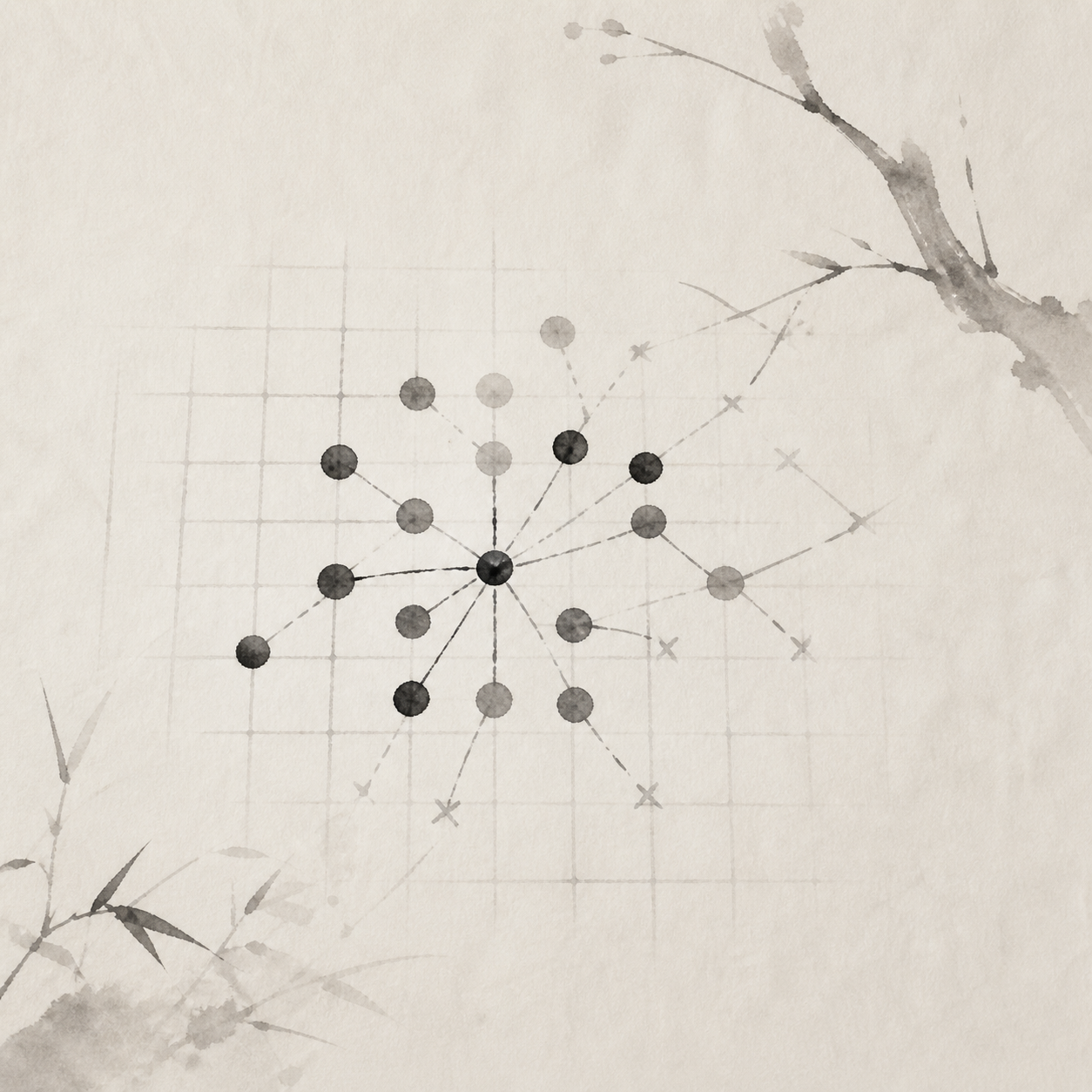
放到五子棋里,搜索负责问“这手之后有哪些强制变化”,评估网络负责估计“这个形状长远是否有利”。有些实验性五子棋引擎会把蒙特卡洛树搜索与 transformer 评估结合使用,用注意力去捕捉远距离棋形,再由搜索检验威胁是否成立。
读评估分,也是在训练自己的眼睛
下一次看引擎复盘,可以少问一句“它为什么喜欢这一手”,多问几个更具体的问题:这手制造了几个必须防的点;它有没有保留两条以上的延展线;对方防住之后,先手还在谁手里。问题越具体,评估分越像解释。
五子棋的魅力正在这里:一颗子落下,棋盘表面很安静,底下的威胁、空间和先后手已经重新排队。试一局时,不妨把数字当作提示,把棋形当作答案。