
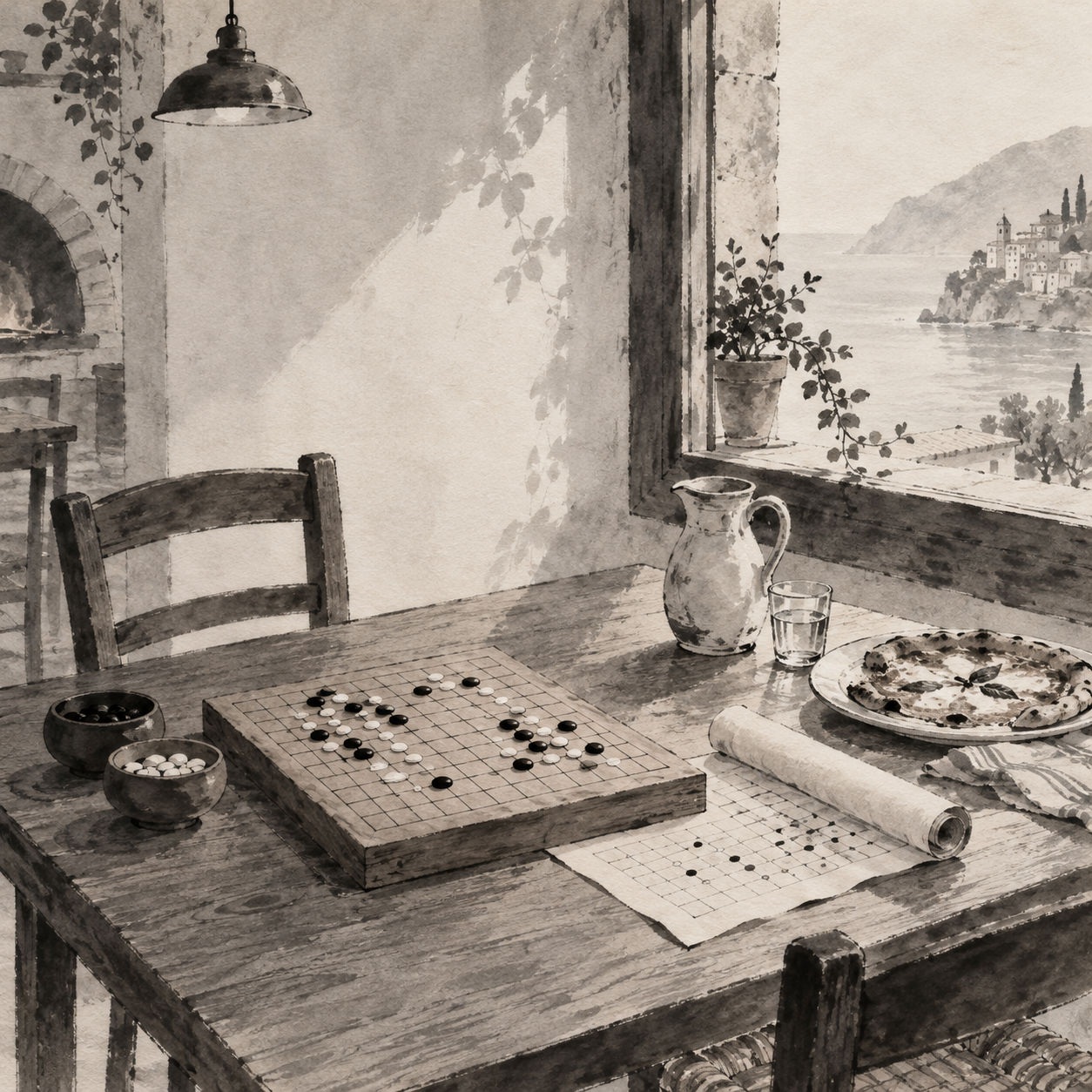
In 1977, after their shifts at Hideaway Pizza in Stillwater, Oklahoma, dishwashers would sit down to play games. Gary Gabrel, an Oklahoma State University student, started with a familiar line-making game and developed what became Pente, according to a July 1983 Inc. interview with him titled “Playing By The Rules.”
Games at the Pizza Place
Gabrel and his coworkers played Go, checkers and games from the Gomoku family. The restaurant gave him a place to set out pieces and watch matches. Turning those games into a set of rules he could sell took more: design, production and a sales pitch. According to the Inc. interview, no established company initially wanted to take on the job.
That places Pente’s beginnings at an actual game table. The goal of making a line remained easy to grasp, but two adjacent stones could vanish on the next move. When you look at the board, you have to watch both long lines and close-range traps. That is the clearest difference from a straightforward five-in-a-row game.
Beyond Five in a Row
Pente is played on a Go-style board with 19 lines in each direction, with White moving first. There are two ways to win: make a line of at least five stones, or complete five custodial captures, removing ten opposing stones in all. A capture takes exactly two adjacent enemy stones. Place your stones at either end of the pair on the same line, and the pair leaves the board.
Suppose a line runs white stone, black stone, black stone, empty point. If White plays on that empty point, the two black stones are removed. If you count only the moves you need to make five, you can miss that threat. A promising line can also break when one of its pairs is captured. Defense means checking adjacent pairs, not just blocking the end of a line.
Within the Gomoku family, Ninuki-Renju is a closer relative: it, too, allows a pair of stones to be captured. The rules page at renju.net specifies a 15-by-15 board and more elaborate opening restrictions. A winning line must contain exactly five stones, and Black may not make an open double-three. Pente uses a similar capture idea but sets its own board size and winning conditions.
A Greek Name
“Pente” comes from the Greek word for five. It refers to both a line of five stones and five pair captures. In the Inc. interview, Gabrel said the people naming the game deliberately avoided a name that sounded “Oriental”; he cited the strength of public feeling about the Vietnam War at the time. It was a deliberate naming decision, not the vestige of some ancient legend.
The history of a name is not the history of the game itself. Oxford English Dictionary citations record “go-ban” in an 1886 travel book and “go-bang” in the Pall Mall Gazette in 1888. Names for related games had entered English, sometimes in altered spellings, long before Pente appeared. Those older words do not show that Pente already existed.
From the Phone Book to a Van
According to the July 1983 Inc. interview, Gabrel sent his rules to ten companies and was rejected by all of them. He later found a collaborator in the phone book who listed himself simply as an “inventor.” Together they registered a copyright and made the first 200 sets. At last, Gabrel had a game he could put in someone’s hands, not just rules on paper.
The same interview reports that, in 1978 and 1979, Gabrel drove a GMC van across the American Southwest and sold about 5,000 sets himself. Money from one town paid for the next few weeks on the road. Newspapers around Oklahoma covered his story. He was still finding places willing to stock the game one stop at a time; Pente had not reached stores nationwide.
The Backgammon Model and the Tube
Pente Games Inc., founded in 1979, secured a $100,000 line of credit in exchange for a 20 percent stake, according to Inc. The company called its approach the “backgammon model”: price the game at $17, aim it at urban professionals ages 18 to 35, and sell it through gift shops and department stores. That choice of outlets also kept Pente away from the mass-market shelves occupied by Monopoly and Stratego.
The packaging changed with the sales strategy. Gabrel told Inc. that, to save money, they replaced a boxed board with a roll-up vinyl mat and a long tube. Packed away, Pente became a slim item on a shelf. The design cut production costs and gave store clerks and shoppers something that looked unlike the usual square-box board game.
Sales soon reached milestones that appeared in print. The Inc. interview and a recap in the summer 1983 Pente Newsletter report that the Oklahoma department store John A. Brown sold 20,000 sets during the 1979 Christmas season. Sales reached 100,000 sets in the first full year and a cumulative 300,000 by the end of the second. The figures give a sense of how quickly distribution grew—and where the claims come from.
The game needed a way onto store shelves, too
After the Sale to Parker Brothers
As sales grew, organized play took shape. According to the Pente Newsletter, the American Pente Association was founded in 1982. It held in-person and correspondence tournaments, maintained ratings and published a quarterly newsletter. A correspondence game could continue across two distant tables; the ratings and newsletter gave regular competitors a record of their play.
A history in Wikipedia’s Pente entry states that Gabrel sold the game to Parker Brothers on July 2, 1983, for an undisclosed sum. Parker Brothers did not hold a 1984 championship. The entry also records that Hasbro stopped publishing Pente in 1993, Winning Moves Games USA brought it back in 2004, and the later Pente Plus added “power stones.” Publishers changed; questions about tournament rules remained with the players.
The First-Move Advantage
One summary of the Pente.org game database excluded games decided on time. Across roughly 750,000 online games, the first player won about 53 percent overall. After lower-rated games were filtered out using rating thresholds of 1800, 2000 and 2200, the figure rose to roughly 58 to 60 percent. The summary does not provide a verifiable analyst’s name, the date of the analysis or its treatment of draws. Those percentages are useful observations, not fixed rates for every tournament.
Tom Braunlich proposed the Pro Tournament Rule to curb the opening advantage. But an interview with 1983 world champion Rollie Tesh in the spring 1984 Pente Newsletter recorded a different view. He thought the rule had failed to solve the problem and suggested considering Renju-style forbidden moves or Keryo Pente. The practical question was whether a new opening procedure would hold up in high-level play.
A GomokuWorld database summary and discussion of the same analysis on BoardGameGeek put the first player’s win rate at about 67 percent when competitive Gomoku used an opening similar to Pente’s Pro Tournament Rule. After Gomoku adopted Swap2, the corresponding figure fell to about 52 percent. Pente games on vint.ee, Board Game Arena and Pente.org later adopted Swap2 as well. This is a timeline of opening-rule changes in two games, not a comparison of samples with necessarily identical filters or treatment of draws. Before comparing win rates, check which opening rules the games used.
Before comparing win rates, check the opening rules