
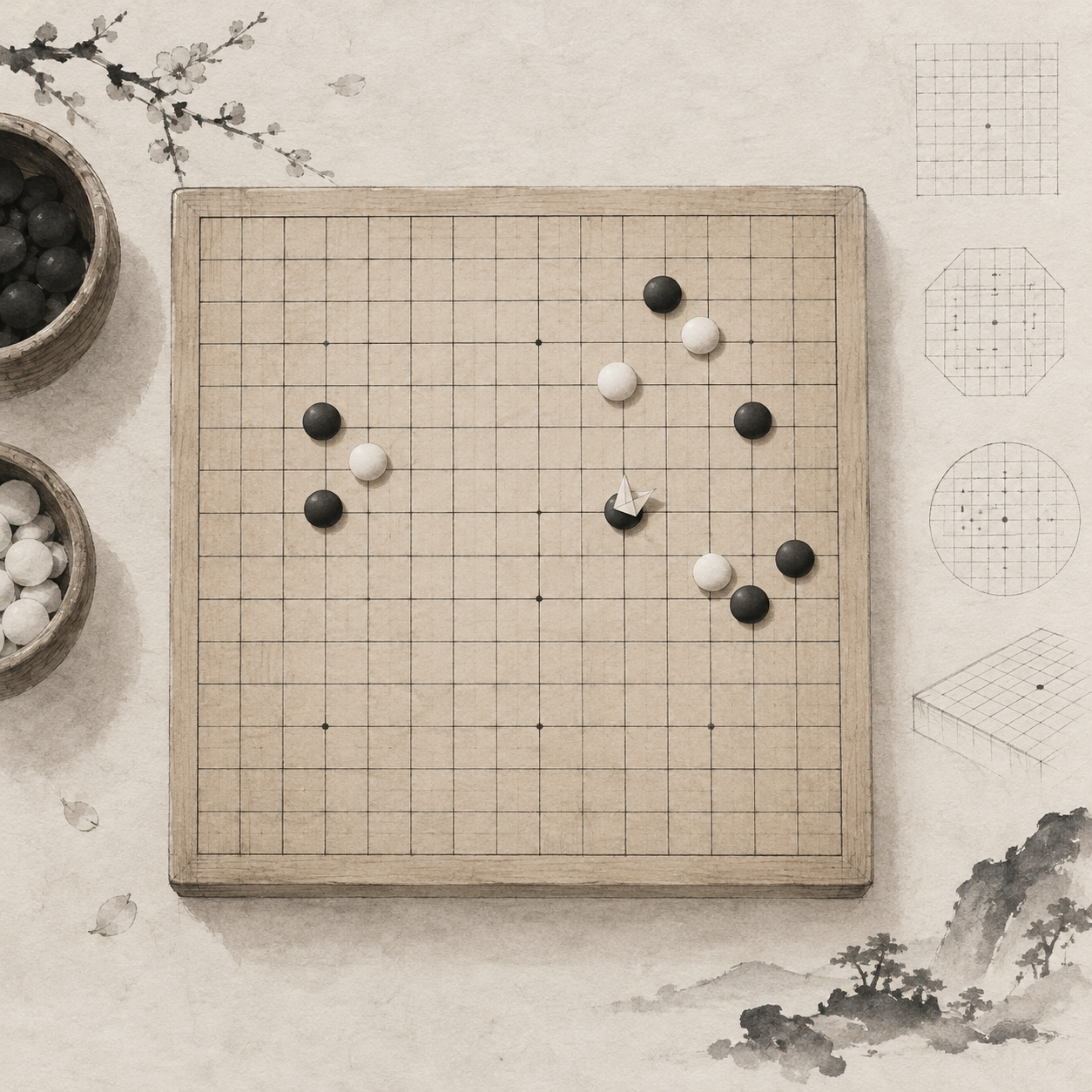
Midgame, you look away from the board for a few seconds. When you look back, you may have to hunt for the stone just played. Among a crowd of black and white stones, the last move does not stand out on its own. How the board marks it affects what you see next—and whether you can recover your thinking when you review the game.
The new stone can disappear
Gomoku is usually played on the intersections of a 15×15 board, with 225 places to play. Early on, the few stones near tengen are easy to remember. As patterns spread across the board, neighboring intersections begin to look alike.
Under the basic rules of Gomoku, players alternate, placing one stone per turn. You set a black stone among a mix of black and white, glance up to consider your opponent’s reply, then look back. The new stone has blended into the position. If you cannot find it, you have lost your starting point for judging what changed.
That starting point matters even more in a review. In the same position, you might notice two black stones in a row first, or your eye might follow a diagonal. Find the previous move, and you can see which connection had just changed. The marker locates the move; the judgment remains yours.
A small flag on a physical board
On a physical board, the solution can be simple: set a small flag on the latest stone, then move it when the next stone is played. The stone stays put. The flag answers only one question: where was the last move? This printable marker flag for Go shows what a separate object can do.
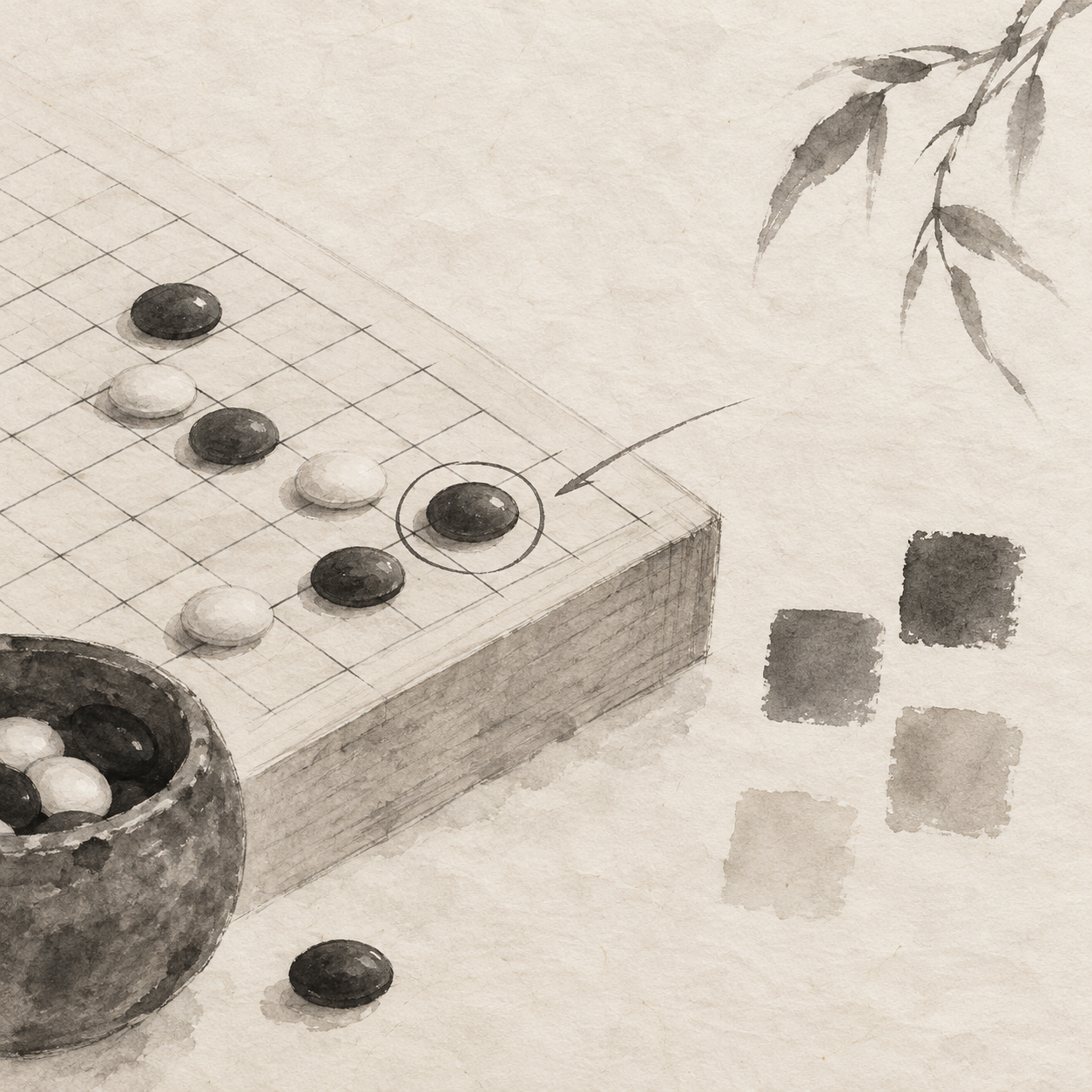
A digital board has no flag to pick up. It must draw that information into the image instead. A short outline at the stone’s edge might work, as might a small symbol. Either way, you should be able to find the move without losing sight of whether the stone is black or white.
Visible, but not in the way
Make the marker too small, and you have to lean in to find it. Let it cover the stone, and you may lose track of the stone’s color. If a white stone lands among black ones and a solid symbol fills its center, you may see the symbol first, then have to check whose move it was. A mark at the edge usually preserves that information.
Color has to work on the board, not just in a palette. WCAG calls for a contrast ratio of at least 3:1 for non-text interface elements that convey information; that is a useful benchmark here. Test the mark on black stones, white stones and crowded intersections. Choosing a color on an empty board is not enough.
Shape can help, but it need not do much. A small notch or short arc at the edge can hold your eye on the right stone. Add an arrow, a flash and a large ring, and nearby intersections become harder to read. You still need the board to see the lines of play; the marker should occupy only a sliver of it.
The marker shows you where. The judgment is yours.
How long should it stay?
During a game, a marker that vanishes before you can register it is little help. Keep it on the current last move until the next stone is placed, then move it. The sequence is clear: only one intersection is marked as the latest.
A review moves at a different pace. Pause at move 40, and you may count stones along a row before checking that move again. The marker should remain on move 40 until you step forward or back. If older markers stay on the board too, the current move must look distinctly different. Otherwise, several marks compete to mean “last move.”
Mark the move, or the whole line?
One stone might create an open three, or threaten in two directions at once. A ring around the last move tells you where the change began. Lighting up an entire line goes further: it chooses a direction for you to examine. Those cues answer different questions and can be confusing when presented as one.
The distinction is sharper with a double-three. If the board lights up both lines first, you may simply count along them, skipping the question of why this move affects two directions. Keep the move marked, look for the connections yourself, then turn to any pattern hint. That leaves room for one independent judgment.
Start your review at the move
Next time you review a game, pause at a move that gave you trouble. With the marker in view, hide what happened afterward for a moment. Ask: Which two earlier stones did this one connect, and which empty intersection did it leave your opponent? Questions grounded in the board are easier to check against what you thought at the time.
Then advance one move and see where your opponent actually played. If they did not block the line you thought was most urgent, step back and count the open spaces at both ends again. As you move through the game, the marker should move with you. You should not have to search the whole board each time.
Finally, write down something specific: “I saw an open three in the upper right but missed the blocking point on the left.” When you encounter a similar position, that will tell you more than “I made a mistake here.” The marker preserves the location; you preserve the reason behind your choice.
Let the marker sit quietly
To test a last-move marker, start with a crowded board. Can you find it at a glance? Can you still make out the stone’s color, the nearby intersections and the diagonals? A mark that looks elegant on an empty board may fail amid the black-and-white patterns of the middlegame.
A good marker catches your eye when you need to find the move, then recedes while you count stones. Pause your review, and it stays firmly on the current move. It does not tell you which line matters. It tells you where to look again.
In a review, find the move first. Then ask what it changed.