
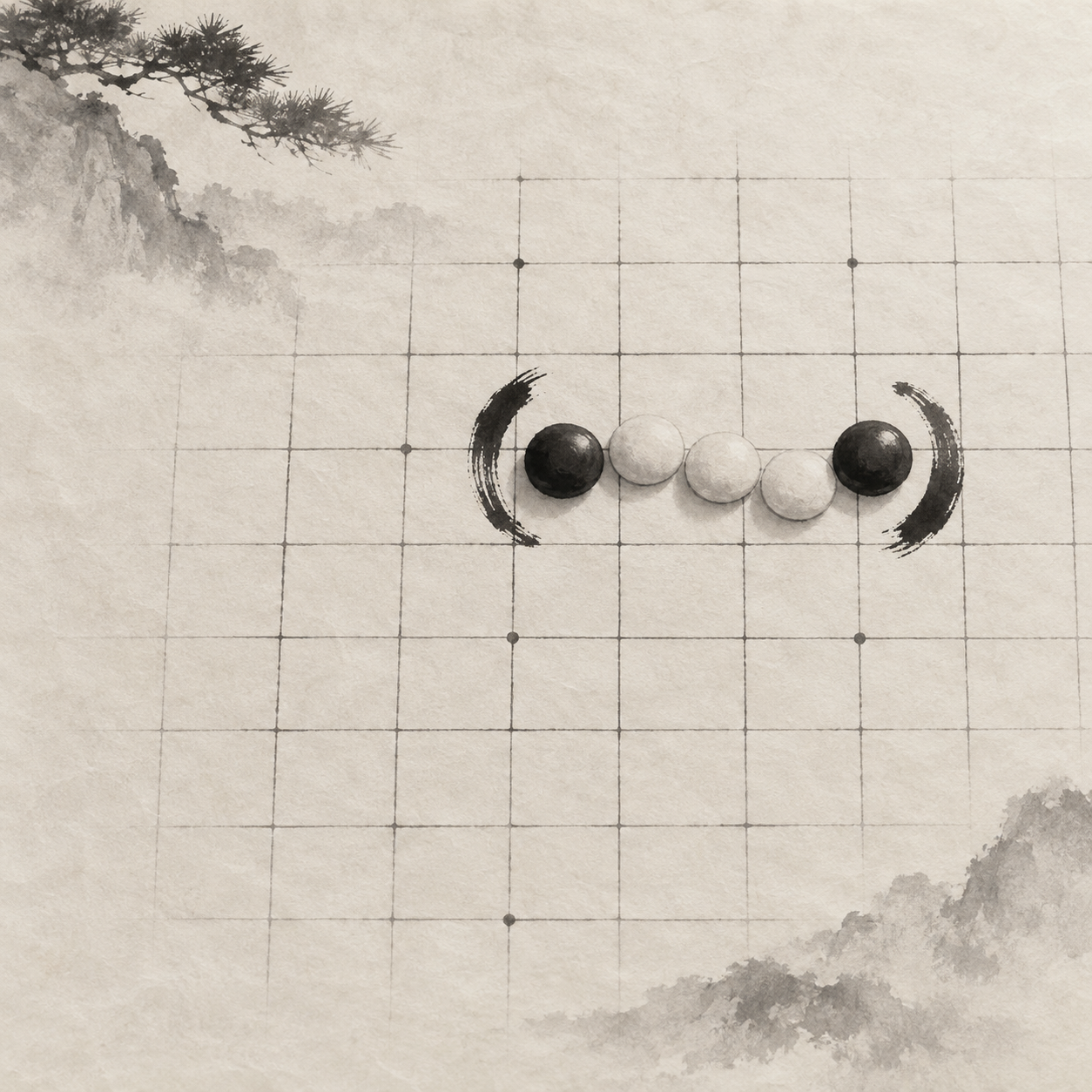
You have two stones in a row, ready to extend. Your opponent takes the points at either end, and the pair comes off the board. If you are watching only for five in a row, you may miss the immediate danger. This form of Renju, with custodial capture added, is called Ninuki-renju.
One Board, Two Ways to Win
Ninuki-renju is played on a 15×15 board, and five in a row remains one way to win. The other is to capture five pairs of your opponent’s stones. Each capture removes two adjacent stones. So when you place a stone, you need to watch not only for lines approaching five but also for pairs that could be enclosed at both ends.
Both paths to victory can develop in the same part of the board. You might extend a line toward five while your opponent uses a nearby point to make a capture. Defending against a capture can, in turn, change where either of you can build a line. Reading both possibilities together is more reliable than counting stones along a single line.
Ninuki-renju also retains Renju’s forbidden-move restrictions for Black, including the double-three and the overline. When considering a move for Black, you must check whether it is legal as well as whether it makes five or captures a pair. The rules are not simply “make five or take stones”; Black’s restrictions still apply.
A Move That Closes Both Ends
Picture four consecutive points on a horizontal line. From left to right, they hold your stone, an opponent’s stone, another opponent’s stone and your stone. Suppose you have just placed the stone on the right. Your stones now enclose the adjacent pair, which is removed. Those four points become your stone, an empty point, another empty point and your stone. One move has changed the local shape of the board.
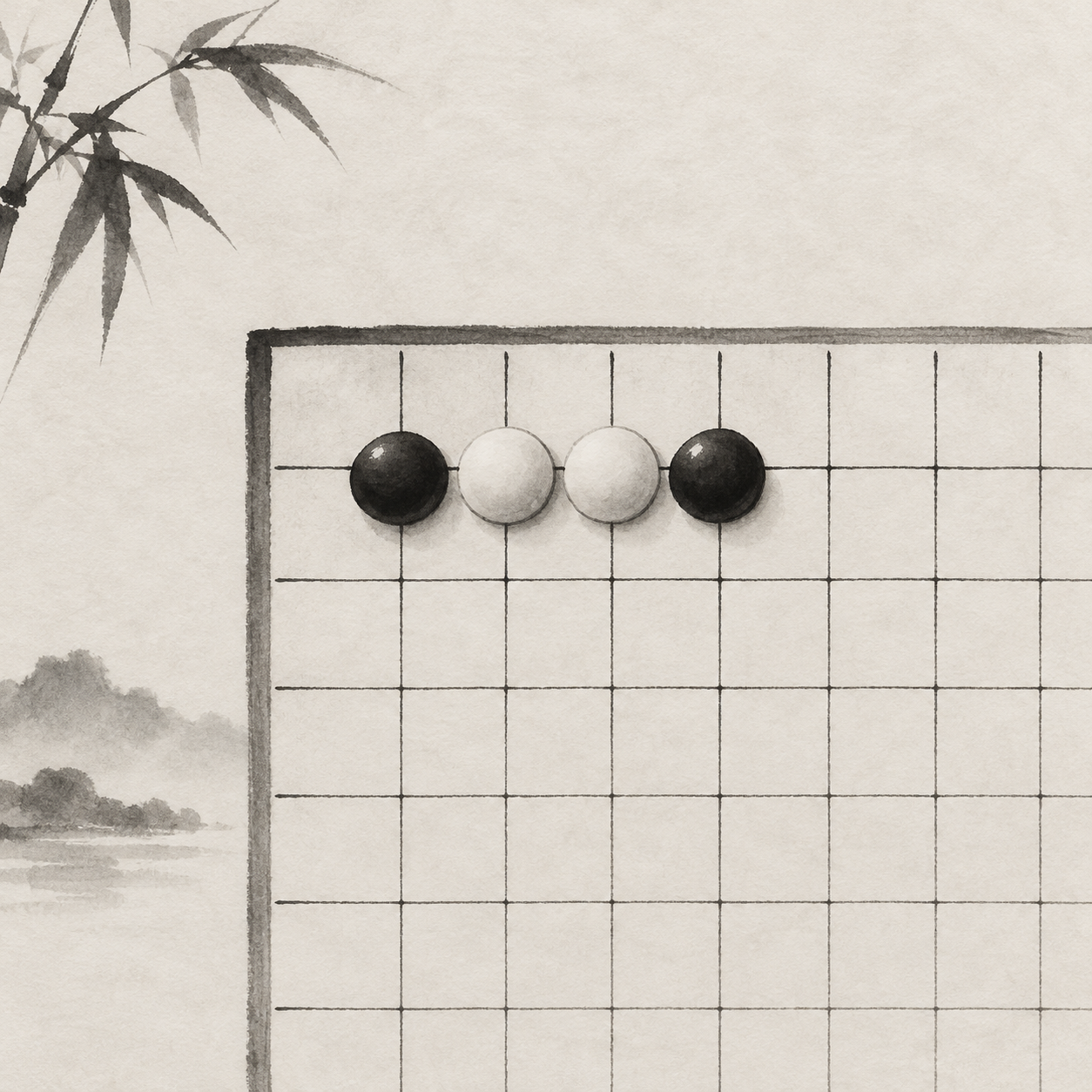
To read this pattern, find the two outer points first. Then check whether exactly two adjacent opposing stones sit between them. If you already hold one end, look for a move that completes the enclosure. If your own pair sits in the middle, check whether your opponent can take that move. The danger is easier to spot this way than by looking only at the length of a line.
A capture depends on stones already standing next to each other; placing a stone at the open end triggers it. At first glance, a cluster of three or four stones may look like a line waiting to be extended. Check its ends from another direction, and you may find a pair exposed to capture. It is worth a second look before every move.
After the Stones Leave
The four-point example does not end with the capture. The removed stones no longer block those points. Any line that ran through the pair must be read again on the changed board: which stones remain connected, and where would another move be needed to join them? A capture does more than bring you closer to the required five pairs.
Before attacking, ask two questions. Does this move advance your line toward five? Is there an adjacent opposing pair you can capture nearby? The opportunities may be close together, but each needs its own check. An extension that looks natural may also leave two of your stones exposed between points your opponent can occupy. Read the shape before choosing a point.
Once the stones are gone, look at the empty points they leave.
The same habit helps on defense. If your opponent can complete a capture, counting the stones already in your line may make it seem more secure than it is. Mentally remove the threatened pair, then reconsider your line and your opponent’s available moves. You will have a clearer sense of whether the capture threat needs attention first.
An Old Book and a Surviving Game
Kubomatsu Katsukiyo (1894–1941) was a Japanese professional Go player of seventh dan and served as head of a Ninuki-renju school. Two dated records place him in this history: his 1923 book, Renju Kizanshū, and a surviving record of a Ninuki-renju game from 1927. One is a publication; the other records a game.
Sources disagree about who invented the game. Some English-language accounts, including Wikipedia, credit Kubomatsu with the “invention” of Ninuki-renju. Japanese researchers dispute that wording, arguing that he is better described as having organized and promoted it. The book and the game record alone cannot settle the difference.
The publication date of Renju Kizanshū and the 1927 game record give us identifiable evidence to work with. They establish Kubomatsu’s connection to this history, but neither proves that he first devised the rules. Keeping those records separate from later claims about authorship makes the limits of the evidence clearer.
What Pente Kept
In 1977, Gary Gabrel created Pente. It, too, allows you to capture an adjacent pair of stones. You can win either by making five in a row or by capturing five pairs. If you know Ninuki-renju, those conditions will look familiar. On a different board, under different rules, though, there are other things to check before you play.
Pente uses a 19×19 Go board and has no forbidden moves. Ninuki-renju uses a 15×15 board, and Black must still obey Renju’s forbidden-move restrictions. Both games let you remove stones in pairs, but you cannot carry the board size or Black’s restrictions from one game into the other.
Set the games side by side and one continuity stands out alongside two differences: the capture rule and its winning condition remain, while the board size and forbidden-move rules change. With those distinctions in mind, you can see which local patterns read the same way—and which moves require you to check the rules of the game at hand.
Check Both Ends Before You Move
Back at a Ninuki-renju board, you can assess a possible move in a short sequence. Look first at your line toward five. Then check whether any adjacent opposing pair can be enclosed. Finally, see whether one of your own pairs faces the same threat. If you are playing Black, check for forbidden moves as well. Each question points you to a particular line on the board, rather than a vague search for a “good move.”
When you spot a possible capture, remove the pair in your mind before planning what comes next. If the position is hard to read, start with four consecutive points and identify the two ends and the pair between them. Set out the stones, read a few moves in that order, then try a game.